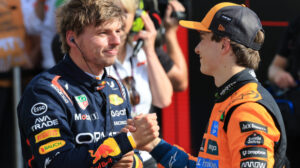


McLaren F1 director Andrea Stella has explained what caused the excessive wear on the wooden floor of Lando Norris and Oscar Piastri’s MCL39s, which cost them 2nd and 4th place in their respective finishes in last Sunday’s race.
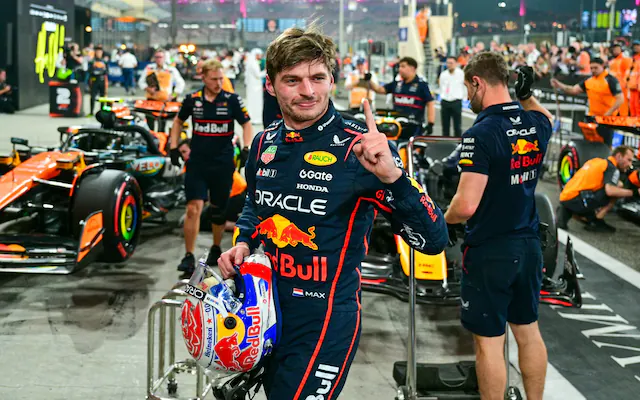
The Briton and the Australian were removed from the final standings after the Las Vegas GP scrutineering, which allowed Max Verstappen to significantly reduce the gap in the title battle – equaling Piastri’s points and closing in on Norris’s 24, two races before the finale of this year’s Formula 1 season.
During the race, the two McLaren drivers were ordered to adjust their driving style, although it is not clear whether this order was given to save fuel in order to reach the checkered flag or to avoid excessive wear on the wooden floor.
We recall that according to regulations, the longitudinal wooden floor of the single-seaters has been there for three decades, so that the FIA can determine through its wear if the single-seaters are dangerously touching the asphalt with their underbelly. Its thickness is 10 millimeters, and the regulations allow wear of up to 1 millimeter.

Speaking about the double elimination in Las Vegas, in the run-up to the Qatar GP this weekend (28-30/11), McLaren F1 team principal Andrea Stella revealed that the team realised early on in the Nevada race that something was wrong.
“From the very first laps, it was clear from the data that porpoising would be a problem,” the Italian explained.
“We were able to better monitor the situation on Lando’s car through telemetry, but our job was made more difficult on Oscar’s car because we lost one of the sensors we use to measure the level of contact with the ground. We quickly realized that these bounces were causing very high wear on the wooden part of the floor, which is why both drivers started making corrective moves at various points on the track.

Unfortunately, the behavior of the car combined with the characteristics of the track made most of these moves ineffective,” Stella added.
An important aspect of Stella’s explanations is that the team did not take any risks in the area of the settings, choosing to set the two MCL39s with a specific and safe level of floor height from the ground.
“The root of the problem was the unpredictable and extensive porpoising, which caused intense vertical oscillations. The level of porpoising was amplified by the operating conditions of the car in the race and had not been seen either in the tests or in the simulations we had done for the car’s ‘window’ of settings.
Based on Friday’s data, we do not believe that we took excessive risks with the height adjustment from the ground. We even added a safety margin for qualifying and the race, but this margin was wiped out by the unexpected intensity of the vertical oscillations,” the Italian continued.
The McLaren F1 director added that even reducing speed, which theoretically increases ground clearance, only helped in some parts of the track, while in others it had the opposite effect.
At the same time, speaking about the penalty, Stella stressed that McLaren accepted it, although the violation was marginal. He also acknowledged that the regulations do not leave any flexibility to the stewards and that perhaps in the future the FIA should consider a more proportionate penalty framework for technical violations that do not give a substantial advantage.
“We confirmed with the technical representative that the measurement was correct,” he said. “Even if the excessive wear was small and only in one spot – 0.12mm for Lando and 0.26mm for Oscar – the regulation is clear: the thickness of the back of the wooden part of the floor must be at least 9mm along its entire length, at the end of the race. Unlike sporting or financial regulations, there is no proportionality in penalties. The FIA has recognised that this must change so as not to lead to disproportionate consequences for small, unintentional infringements that do not provide substantial performance.

And we must also remember that the FIA also pointed out that the violation was not intentional, there was no intention to violate and there were clear mitigating circumstances, which we explained to the stewards”.
Closing, Stella expressed his confidence that the issue will not be repeated in the last two races of the season. “The conditions we faced in Las Vegas were very specific for the ‘window’ of operation of the car and for the characteristics of the track.
We have a solid and tested process in the set-up of the car and we are confident that it will guide us to the right choices from Qatar onwards. Nevertheless, every experience is a lesson and what happened in Las Vegas gave us useful information about the behavior of the car under extreme bouncing conditions”, concluded Andrea Stella.